The Media Marathoning researched forced me to think a lot about spoilers. Unless enjoying a whole season drop (such as Orange is the New Black or House of Cards), marathoners must time shift (watch episodes after their air date). Time shifting is an agentic move that allows viewers to watch on their own schedule; however, it opens them up to the perils of spoiling–if spoilers are indeed seen as perilous.
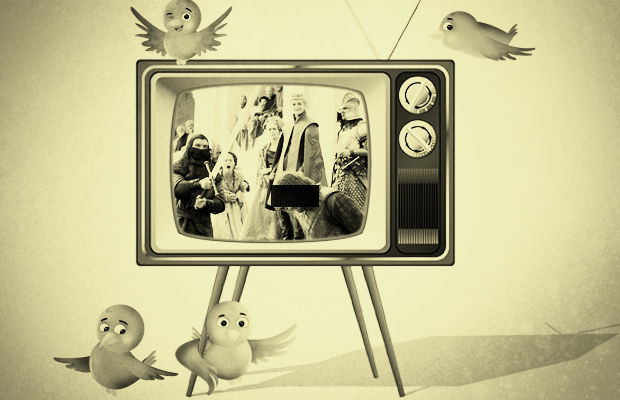
Image from complex.com
Noelle McElrath-Hart and I (with research help from Julia Keiper) explored many dynamics of spoilers. Our first spoiler study was accepted this spring by Convergence: The International Journal of Research into New Media Technologies.
Here is the abstract:
Analysis of discourse gathered from 92 television time shifters reveals varying attitudes and behaviors toward spoilers. We found that all study participants’ spoiler behaviors could be classified into one of four categories: avoid (N=47, 51%), seek (N=7, 8%), ambivalent (N=26, 28%), or disinterested (N=12, 13%).Throughout this essay, we argue that spoiler avoiders embrace post-network era reception practices, but use network era norms to evaluate their own experience and regulate the television conversations around them. We see, however, an erosion of those network era norms in people who either use spoilers to enhance their narrative pleasure or who do not actively police television conversations around them. These findings suggest that television conversation norms and individual evaluations of narrative pleasures are slower to evolve than reception patterns. Our study brings convergence culture questions of narrative pleasure, discursive patterns, active audience behaviors and contested grounds of power to the surface.
I carefully read the SAGE contributor agreement to learn my rights. And, hey, I have some rights. I can post the article to my personal website or blog (not to Academia.edu just yet). So here is the full article:
Convergence Spoilers Revision Final April 2016.
I know it goes against the principles of blogging to not update your blog frequently (guilty here), but I encourage academics to start blogs if just to get their work out earlier. Or you can just flout your publishing contract and post your work widely, a move that I also support.


Pingback: Putting the “Reach” Back in Research | Media Marathoning
Can you be more specific about the content of your article? After reading it, I still have some doubts. Hope you can help me.
Thank you for your sharing. I am worried that I lack creative ideas. It is your article that makes me full of hope. Thank you. But, I have a question, can you help me?
Thank you, your article surprised me, there is such an excellent point of view. Thank you for sharing, I learned a lot.
Very well presented. Every quote was awesome and thanks for sharing the content. Keep sharing and keep motivating others.
I appreciate you sharing this blog post. Thanks Again. Cool.
very informative articles or reviews at this time.
I am truly thankful to the owner of this web site who has shared this fantastic piece of writing at at this place.
Good post! We will be linking to this particularly great post on our site. Keep up the great writing
Thanks for sharing. I read many of your blog posts, cool, your blog is very good.
I don’t think the title of your article matches the content lol. Just kidding, mainly because I had some doubts after reading the article.
Pingback: order androxal generic health
Pingback: order enclomiphene price canada
Pingback: ordering rifaximin australia over the counter
Pingback: purchase xifaxan purchase line
Pingback: online order staxyn price from cvs
Pingback: discount avodart us overnight delivery
Pingback: cheapest buy dutasteride cheap store
Pingback: online order flexeril cyclobenzaprine buy hong kong
Pingback: buy cheap gabapentin canada internet
Pingback: generic fildena online next day
Pingback: itraconazole compare price
Pingback: acheter du kamagra en pharmacie sans ordonnance
Pingback: pharmacie canadienne en ligne kamagra
Your article helped me a lot, is there any more related content? Thanks!
Can you be more specific about the content of your article? After reading it, I still have some doubts. Hope you can help me.
Thanks for sharing. I read many of your blog posts, cool, your blog is very good.
I don’t think the title of your article matches the content lol. Just kidding, mainly because I had some doubts after reading the article.
Thank you for your sharing. I am worried that I lack creative ideas. It is your article that makes me full of hope. Thank you. But, I have a question, can you help me?